

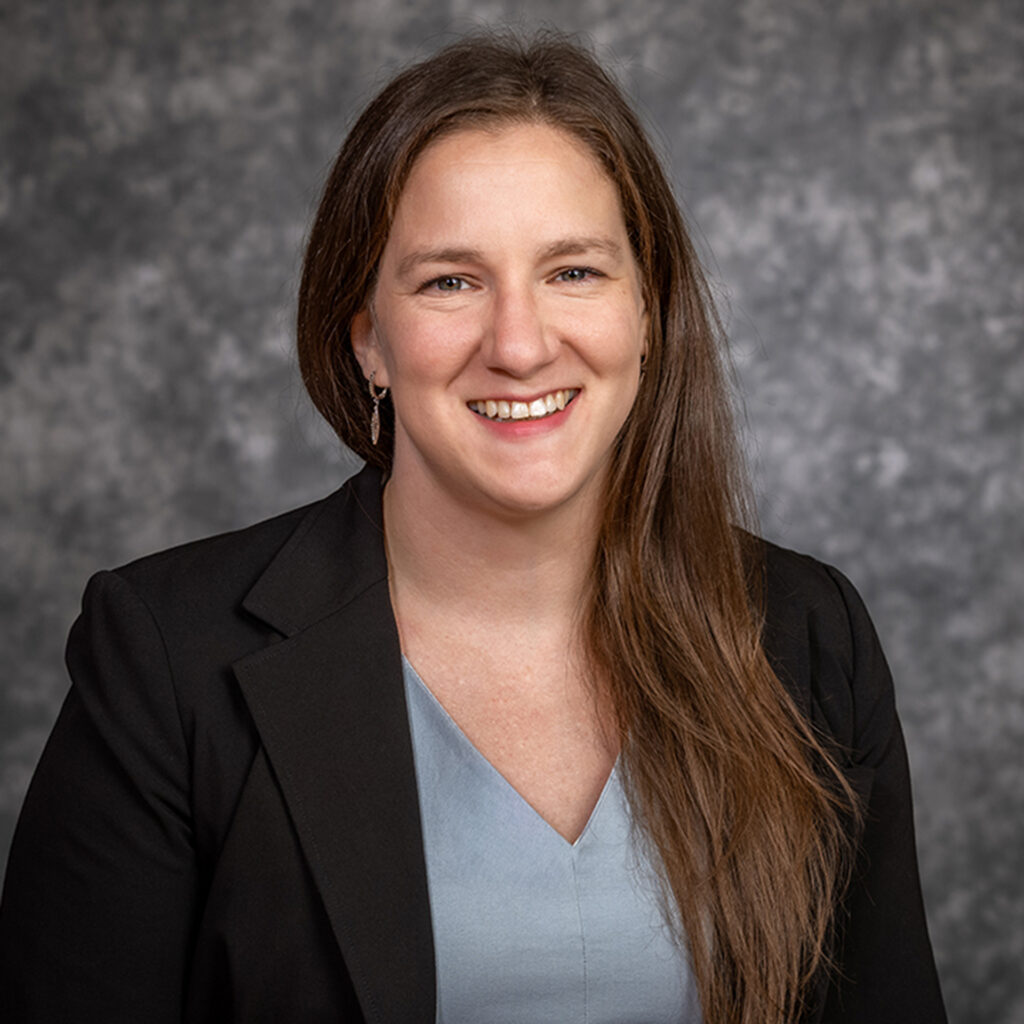
Amelia Miramonti joined the Nebraska Statewide Workforce & Educational Reporting System (NSWERS) in July 2025, bringing more than a decade of experience in research, with eight years working specifically with education-related research. She earned both her Doctor of Philosophy in Interdisciplinary Studies, with majors (and specializations) in Educational Psychology (Quantitative, Qualitative, & Psychometric Methods) and Human Sciences (Exercise Physiology), and her Master of Arts in Educational Psychology from the University of Nebraska–Lincoln (UNL). She is also an alumna of the University of Central Florida where she earned master’s and bachelor’s degrees in Exercise Science with specializations in Applied Exercise Physiology and Human Performance, respectively.
Dr. Miramonti’s professional expertise spans quantitative methods, research design, exercise physiology, sport science, positive youth development, and cognition in sport. Dr. Miramonti’s work has been recognized through numerous awards and fellowships, including the Plake Fellowship, the Othmer Fellowship, and multiple national and university-level scholarships. Her scholarship is widely cited, with more than 1,600 citations to date.
Alongside her position at NSWERS, she currently holds a collaborative research role at the University of Nebraska Public Policy Center and a supervisory role mentoring graduate students in the Nebraska Evaluation & Research (NEAR) Center. Dr. Miramonti has previously worked in the Nebraska Academy for Methodology, Analytics & Psychometrics, Nebraska Extension (in 4-H Youth Development and the Nutrition Education Program/SNAP-Ed), and the former Neuromuscular Research & Imaging Laboratory.
As a postdoctoral researcher at NSWERS, Dr. Miramonti leads the development and implementation of synthetic data procedures. She utilizes advanced statistical methods and tools to generate synthetic datasets based on NSWERS’s research data warehouse. Her work supports secure data sharing, enables training and demonstration uses, and strengthens NSWERS’ ability to provide high-quality, privacy-preserving resources for research and policy analysis.
Committed to mentorship and service, Dr. Miramonti has guided students through the Ronald E. McNair Scholars Program and the Undergraduate Creative Activities and Research Experience (UCARE), mentored graduate students in the NEAR Center, and served as a reviewer for leading journals and professional associations. Dr. Miramonti brings both methodological expertise and a passion for applied research to NSWERS, greatly influenced by the mentorship of her doctoral advisor, Dr. Jim Bovaird.
Originally from Lebanon, New Hampshire, she enjoys traveling, hiking, rock climbing, martial arts, and cooking. Dr. Miramonti previously played rugby for nearly 20 years, holding player-leadership roles on several teams and later serving as an assistant coach for the Men’s Rugby Club at UNL. A lifelong dog lover, she’s eager to adopt a pup in the near future.
Get to Know Amelia
If I wasn’t in my field of work, I would probably be:
An engineer or neurophysiologist working with neuromotor control of prosthetics, or a backcountry hiking/climbing/whitewater rafting guide or National Park Ranger.
What’s the biggest misconception people have about your position?
Either that I use Excel 90 percent of the time (instead of ~10 percent of the time) or that there’s a simple, straightforward, “right” answer to most statistical questions.
When you were a kid, what did you want to be when you grew up?
I would often answer this question with ‘happy.’ While true, it was my sort of clever non-answer, so that I didn’t have to choose only one thing. I’ve had so many interests it’s no surprise that I ended up with an interdisciplinary degree.
What is a fun or interesting fact about your hometown?
It’s where Phineas Gage survived an accident in which an iron rod went through his skull and frontal lobe, causing permanent changes to his personality. His experience influenced contemporary scientific understanding of the neurological basis of personality, helping to launch the field of neuropsychology.